How to Optimize Your Health for Longevity (And Why Most People Are Thinking About It Wrong)
Most people think about longevity the wrong way. They focus on living longer, adding years to their life. But the question that actually matters is this: how many of those years will you be able to do the things that make life worth living?
At Reload PT & Fitness in New York City, we work with people every day who are not just trying to extend their lifespan. They are trying to extend their healthspan. And that distinction changes everything about how you approach your health.
This guide draws on the research and philosophy that drives everything we do at Reload, from pain science and movement neuroscience to behavioral change and long-term physical capacity. If you want to know how to genuinely optimize your health for longevity, this is where to start.
Longevity is not just about how long you live. It is about how well you live, and whether you can do what matters most to you well into your seventies, eighties, and beyond.
Healthspan vs. Lifespan: The Distinction That Changes Everything
Lifespan is straightforward. It is the total number of years you live. Healthspan is more nuanced: it is the number of years you live in good health, free from debilitating disease or disability, with the capacity to engage fully in your life.
Americans now spend an average of 12.4 years in poor health before death. That means nearly 15% of the average lifespan is spent managing disease, losing independence, or living with significant limitation. The goal is not to simply live longer. It is to compress the period of decline and stay strong, capable, and engaged for as long as possible.
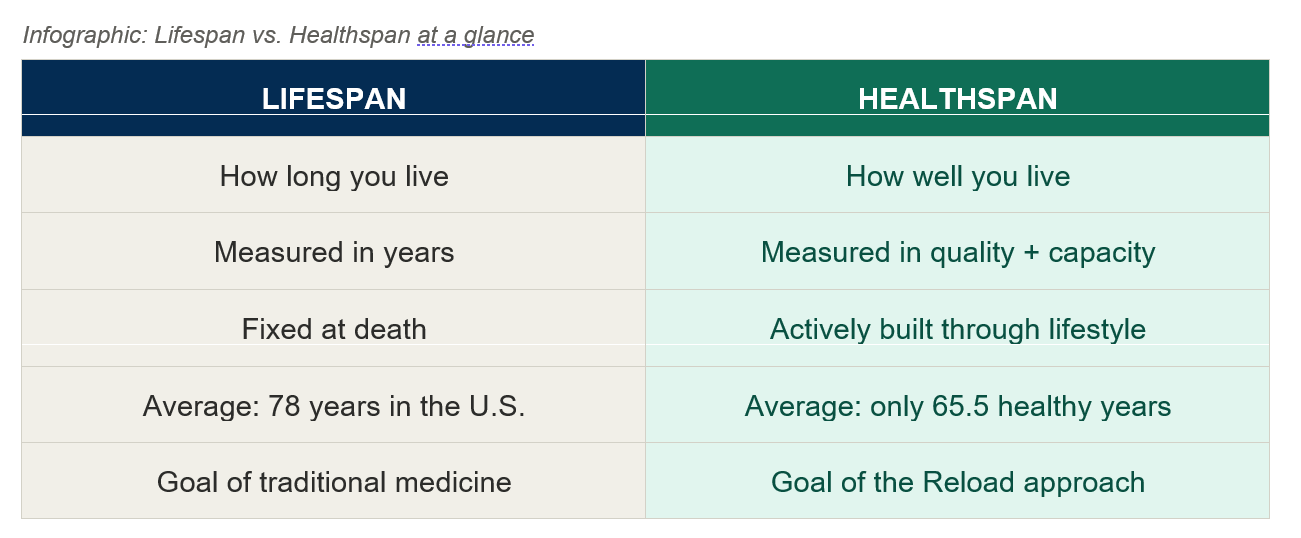
Infographic: Lifespan vs. Healthspan at a glance
Biological Age vs. Chronological Age: You Have More Control Than You Think
Chronological age is simply how many years you have been alive. Biological age is how old your body actually functions, at the cellular, tissue, and organ level.
These two numbers can be very different. Research from the Danish Twin Study shows that only about 20% of longevity is determined by genetics. The remaining 80% is shaped by lifestyle, including how you move, sleep, eat, manage stress, and stay connected to others.
The markers of biological age are not fixed. They respond directly to how you train and live. And the findings are more encouraging than most people realize.
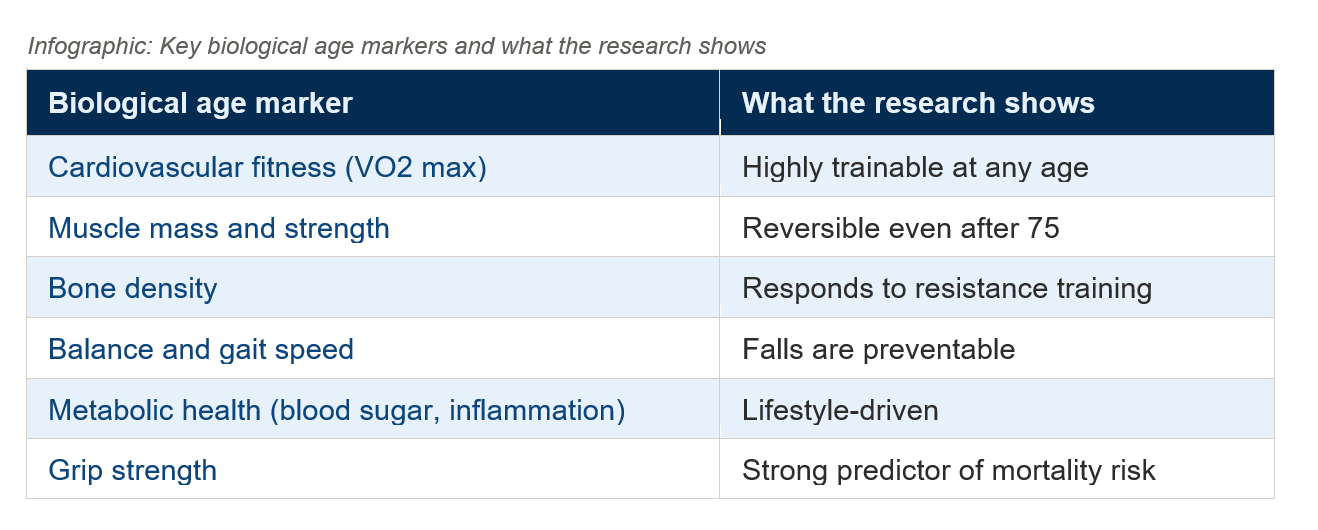
Infographic: Key biological age markers and what the research shows
Chronological age is how many candles are on the cake. Biological age is how old your body actually feels and functions. One is fixed. The other is not.
Pain and Fear-Avoidance Are Quietly Aging You Faster
One of the most underappreciated threats to healthy longevity is not a disease. It is the behavior that chronic pain produces: avoidance.
Chronic pain affects over 100 million Americans, more than heart disease, cancer, and diabetes combined. And the most common response to pain is to move less, protect more, and wait until it feels safe to re-engage. This response feels logical. But the research tells a different story.
When pain feels threatening, the brain activates a protective response. Movement gets tagged as dangerous. The nervous system becomes more sensitive. And here is the critical insight: avoidance does not reduce pain sensitivity. It increases it.
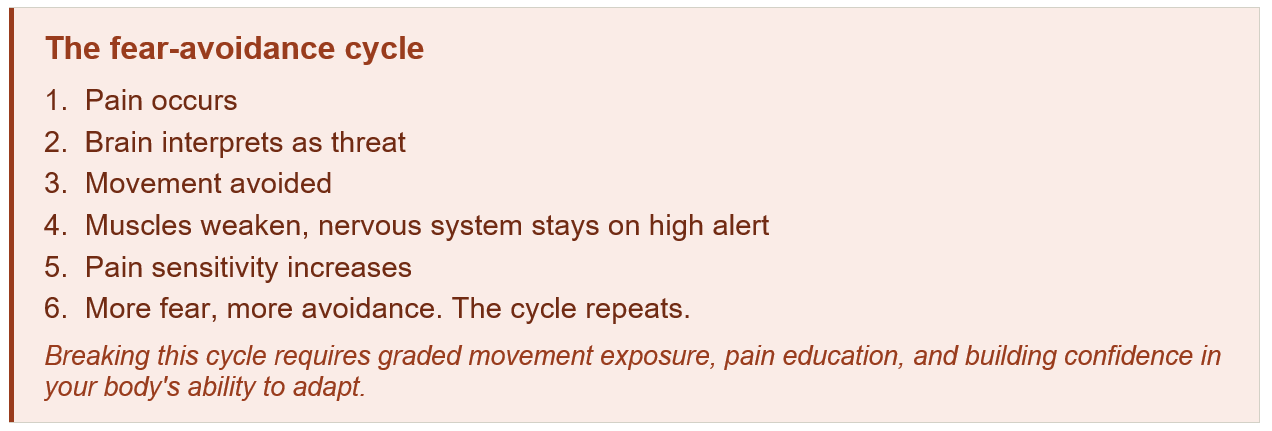
The fear-avoidance cycle
What actually predicts how long pain lasts and how disabled it makes you? Not tissue damage. Not what shows up on a scan. Research consistently shows that beliefs about pain, specifically the belief that pain means harm and that movement is dangerous, are the strongest predictors of long-term disability.
Optimizing your health for longevity means understanding pain as information, not punishment. It means learning to distinguish between hurt and harm. And it means building the confidence to keep moving, gradually, safely, and consistently, even in the presence of discomfort.
The Physical Activity Non-Negotiables for Long-Term Health
Only 28% of American adults meet the CDC's Physical Activity Guidelines for both aerobic and strength exercise. Physical inactivity is responsible for more than 5 million deaths worldwide each year. And yet most healthcare interactions never meaningfully address it.
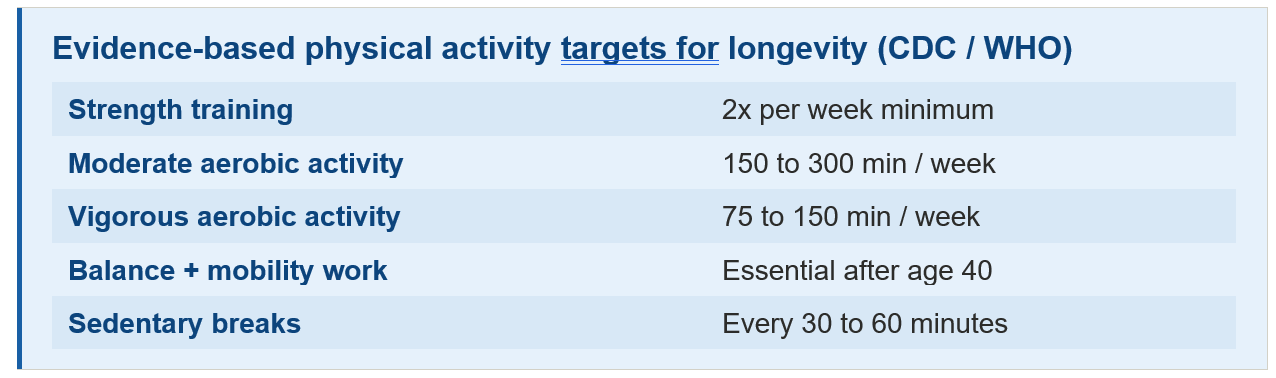
Evidence-based physical activity targets for longevity
But quantity alone is not the answer. The right dose matters. Training too little produces no adaptation. Training too much without adequate recovery produces breakdown. The goal is progressive, well-managed stimulus, with stress, recovery, and adaptation applied systematically over months and years.
The Reload Approach: Function First, Then Longevity
At Reload, we operate from a simple but powerful philosophy: function first, then healthy longevity. We are not interested in abstract health goals 30 years from now. We are interested in helping you do the things that matter to you today, and building the physical and psychological capacity to keep doing them for decades.
This means we do not just treat pain. We treat the beliefs, behaviors, and movement patterns that determine how pain affects your life. We build long-term physical literacy, the knowledge, confidence, and capacity to navigate your own health as your life, goals, and body evolve.
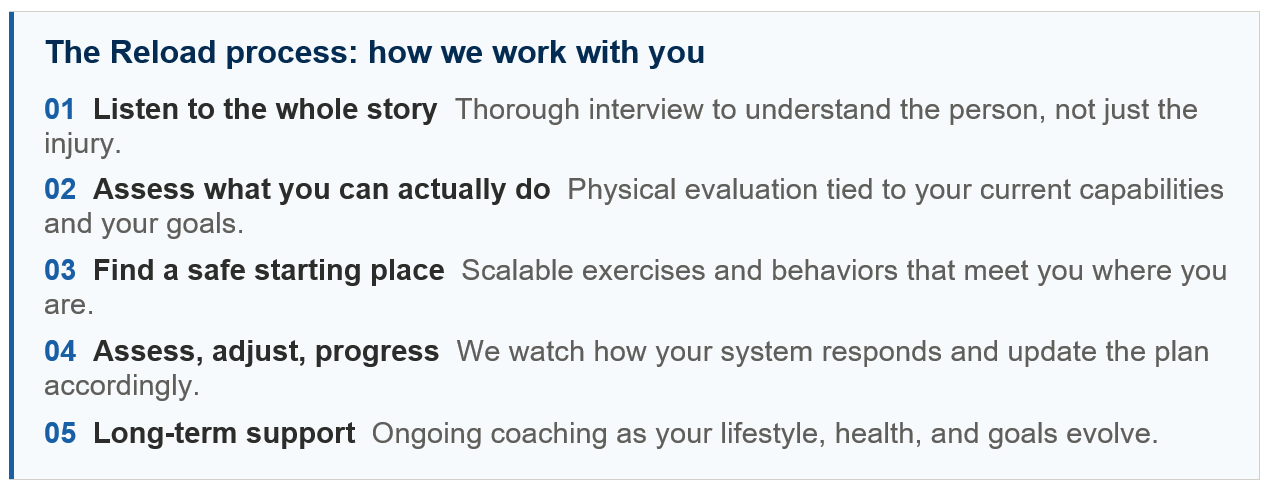
How the Reload process works
We don't just treat a body part. We listen to the whole story, then design a plan that meets the full person.
Ready to Optimize Your Health for the Long Game?
Longevity is not a product you buy or a biohack you try. It is the result of consistent, intelligent movement, an educated relationship with your body, and a team that holds you accountable to the life you actually want to live.
At Reload PT & Fitness in New York City, we help people build exactly that, not in sessions, but over years.
If you are ready to stop chasing short-term fixes and start building long-term capacity, we would love to work with you.
Book your first session here follow us at @reload.pt for more on pain science, movement, and healthy longevity.
