How to Periodize Training for Longevity: Weekly and Seasonal Cycles
Train Today for the Body You Want at 80
Training is not just about the next race, the next season, or the next vacation. It is about the body you want to live in decades from now. If you want to travel, pick up grandkids, hike, or play your sport without stressing every move, you need a plan that respects both performance and longevity.
That is where periodization comes in. In simple terms, periodization means planning changes in how hard you train, how much you do, and what you focus on across weeks and seasons. Instead of repeating the same workouts until your body complains, you move through planned waves of stress and recovery so you keep making progress while lowering your risk of plateaus and injuries.
Pain and injury are rarely about one single thing. Training load, sleep, stress, past injuries, and health conditions all blend together. Smart planning cannot control everything, but it can help you manage many of these pieces so your body is better prepared for what you ask of it.
At Reload Physical Therapy and Fitness in New York, we mix physical therapy, strength training, and health coaching to build periodized plans around real people. Our goal is not to turn everyone into an athlete. It is to use the same principles athletes use, scaled to your life, history, and goals. Because the right program is the one that fits the person, not the one that looks best on social media.
Periodization is not just for pro athletes. It is the difference between training hard for a month and quitting versus training smart for a lifetime and compounding. That is how you build the body you actually want to live in at 80.
Why Periodization Matters More as You Get Older
As we age, we can still get stronger, fitter, and more capable, but the way we recover and adapt often changes. Muscle can take longer to bounce back, tendons may feel stiffer, hormones shift, and life usually brings more work, family, and stress on top of training.
Without some structure and variation, a few patterns tend to show up. Strength or endurance stalls even though you are working hard. Little aches turn into nagging pains that do not quiet down. Overuse injuries appear after a sudden ramp-up in miles or loads. Motivation crashes, especially in late winter when energy is low.
Good weekly and seasonal cycles give your body enough challenge to improve while still leaving space for recovery, life events, and flare-ups. Instead of going all out for a month, then backing off for two months because something hurts, you work in repeatable waves. This supports peak performance and longevity, not just a short-term push.
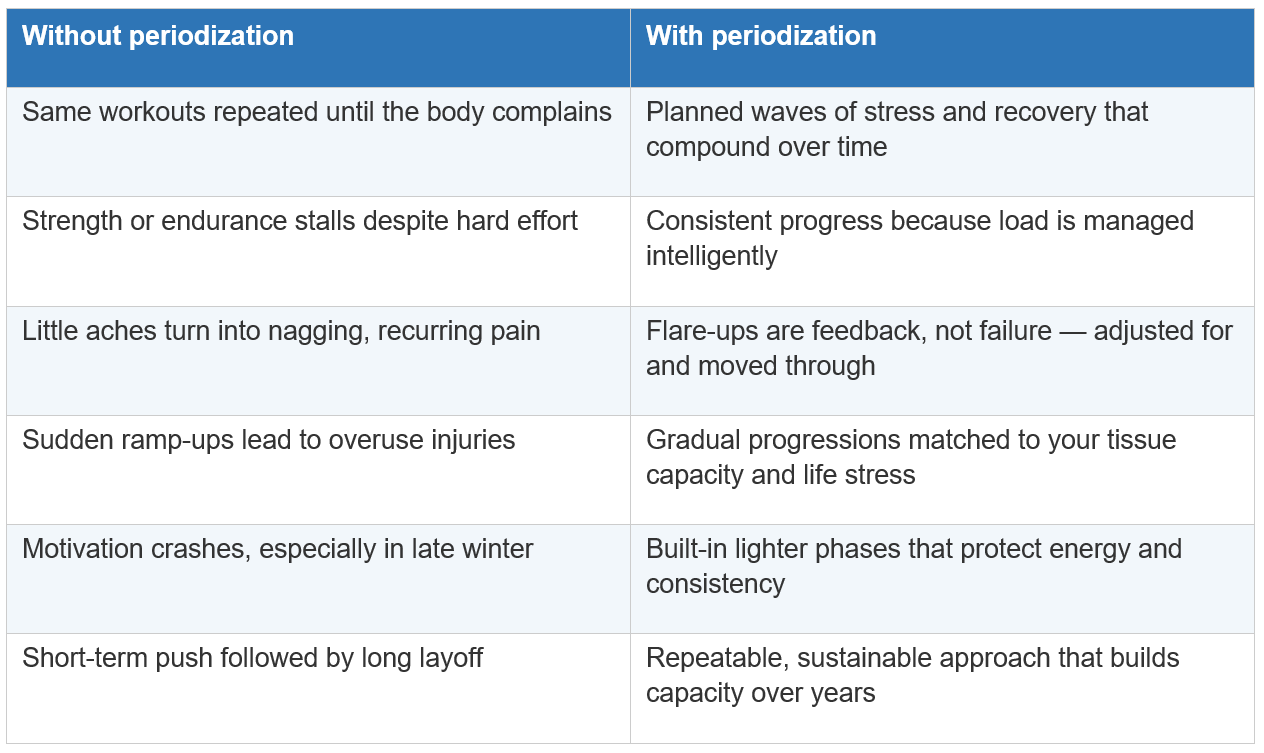
What happens without periodization vs. with it
The Building Blocks of a Longevity-Focused Training Week
A training week for longevity usually includes a few key parts. The exact mix depends on your history, schedule, and goals, but most people benefit from some blend of strength training to keep muscle, protect joints, and support daily tasks, aerobic conditioning for heart health, stamina, and energy, mobility and movement prep so you feel ready, not rusty, when you move, and real recovery like sleep, walking, and low-intensity movement.
For long-term success, it helps to think in terms of the minimum effective dose instead of the maximum you can tolerate. Many adults make better progress with reasonably hard but repeatable weeks than with rare, heroic workouts that leave them wiped out. Your body adapts to consistent stimulus, not occasional punishment.
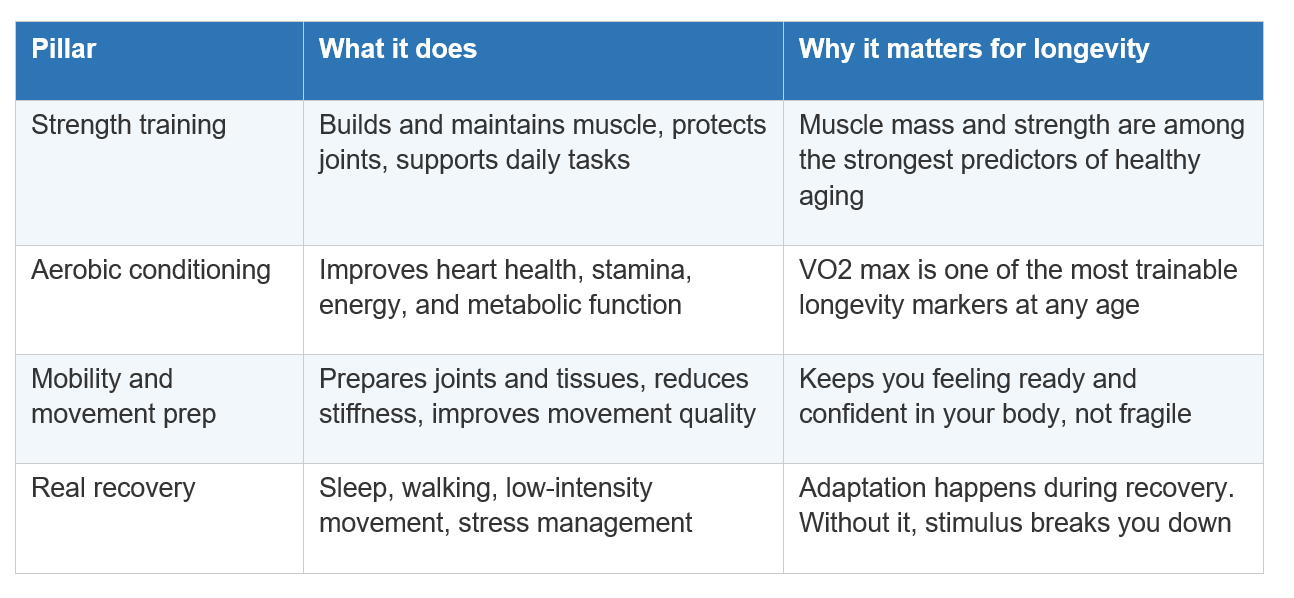
The four pillars of a longevity training week
Simple ways to periodize your week include alternating hard and easy days instead of going hard every day, mixing focus areas like upper body one day and lower body the next, blending cardio intervals on some days with steady easier cardio on others, and adjusting volume during weeks with big work deadlines or family stress.
If you have a history of back pain, knee problems, or other injuries, you may need slower progressions and more frequent check-ins with a clinician. The weekly template is still useful. It just needs to be personalized, because pain and injury are rarely about one single thing.
Function first, then healthy longevity. We are not interested in abstract health goals 30 years from now. We are interested in helping you do what matters today, and building the capacity to keep doing it for decades.
Seasonal Cycles That Match Real Life and Weather
Late winter is a common time for burnout. Many people go hard in January, then feel tired, sore, or bored by the end of February, especially with cold New York weather keeping them indoors. This is the classic boom-bust cycle, and it is one of the biggest enemies of long-term progress.
A planned recalibration phase can help you step back just enough to stay consistent instead of quitting. One helpful frame is to think in 8- to 16-week blocks through the year, and then adjust for your life.
One helpful frame is to think in 8- to 16-week blocks through the year, and then adjust for your life:
Winter to early spring: Rebuild strength and general capacity, clean up technique, and work on nagging issues before outdoor activity picks up.
Late spring to summer: Shift toward more outdoor endurance and power. Gradually build running, cycling, hiking, or sport work instead of jumping straight to high volume.
Fall: Hold on to strength gains, keep a steady base, and avoid the “fall sprint” of cramming too much too soon after a more relaxed summer.
These patterns are only starting points. Your calendar should reflect your body and goals. Previous injuries like an ACL tear, tendon pain, or recurring back issues, along with health factors like arthritis or metabolic health, all shape what your year should look like. There is no single correct template, only frameworks to customize.
The same principle applies to life seasons. When work stress spikes, a family schedule changes, or you sign up for a race, your body is responding to all of those shifts at once. Physical and non-physical stress add up in the same bucket. A smart plan accounts for that reality instead of pretending training happens in a vacuum.
Progressing Load Without Pushing Into Injury
Progress comes from giving your body a bit more challenge than it is used to and then letting it adapt. This is the SRA model in action: stimulus, recovery, adaptation. Too little stimulus means no adaptation. Too much means breakdown. The right dose means growth.
In practice, that often means gradually increasing one variable at a time: total weekly volume like sets, reps, or minutes, intensity like load on the bar or speed on the bike, or complexity like adding single-leg moves or faster changes of direction.
A simple rule of thumb is to pay attention to how you feel 24 to 48 hours later. Soreness, some fatigue, or mild joint stiffness can be normal. Red flags are pain that keeps rising, soreness that does not ease after a couple of days, or a clear drop in sleep or mood that does not match the rest of your life.
Tools like rate of perceived exertion, where you rate how hard something feels on a simple scale, can guide daily choices. So can quick checks on sleep quality, energy, mood, and stiffness. For adults juggling work, caregiving, and stress, these signals often matter as much as the numbers on the bar.
Pain itself is complicated. It is not always a sign of new damage, and pain and injury almost never have a single cause. Load, tissue capacity, stress, sleep, and past experiences all mix together. Hurt is not always harm. Sensitivity is not always severity. Pain relief is not always recovery. If pain is persistent or getting worse, it is better to work with a clinician than to copy a random program online.
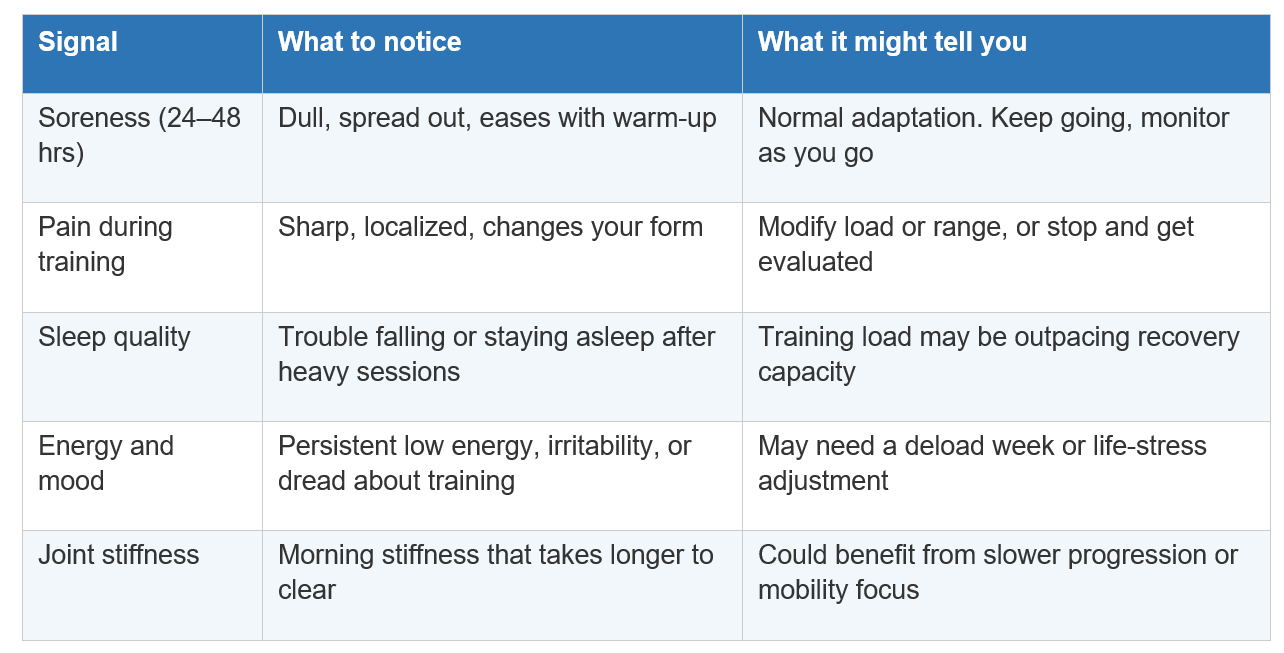
Self-monitoring signals to track weekly
Blending Rehab, Strength, and Health Coaching for Longevity
A performance and longevity clinic like Reload is set up to bridge the gap between rehab and training. Instead of stopping at symptom relief, we help people build toward strength, power, and resilience inside an individualized plan.
This often means:
Starting in a rehab mode when pain or injury is front and center
Gradually shifting into more traditional strength and conditioning
Keeping an eye on movement quality without chasing “perfect” form
Adjusting load when life stress, sleep, or work demands spike
Health coaching can be periodized too. During higher training phases or demanding life seasons, you might put more attention on sleep, stress management, and daily movement patterns. On lighter training blocks, you might focus on skill work, technique, or building new routines.
The same core ideas that help competitive athletes reach peak performance and longevity, like planned variation, monitoring response, and technical coaching, also work for busy professionals, older adults, and people coming back from injury. The “right” program is the one that fits your history, goals, and current context, not the one that looks best on social media.
Turn Your Next 12 Weeks Into a Longevity Experiment
One practical step is to treat the next 8 to 12 weeks as a small experiment. Set a realistic goal, like improving your squat, walking up stairs with less effort, or getting through a hike without knee pain. Then outline a weekly structure, plan one or two lighter weeks, and decide in advance how you will adjust if life gets hectic.
Track basic training details, but also keep notes on sleep, energy, and any pain or flare-ups. Look for patterns across weeks instead of reacting to a single “bad” day. If you have a history of injury or complex health issues, working with a physical therapist or performance coach can help you shape this experiment so it is challenging but still safe for you.
Longevity is not about perfection or rigid discipline. It is about stacking reasonable, informed choices over time. With thoughtful weekly and seasonal cycles, you can keep moving, enjoy what you love, and build your own version of peak performance and longevity for the long run.
The goal is not perfection. It is participation. Consistent, supported, values-driven movement is what builds a life you can keep living fully.
Take The Next Step Toward Moving And Living Better
If you are ready to train smarter and feel stronger for the long term, our team at Reload Physical Therapy and Fitness is here to guide you. We combine physical therapy, strength training, and health coaching into one plan built around your life, your history, and your goals.
Explore how our coaching and programming are built around peak performance and longevity so you can keep doing what you love at a higher level and with fewer setbacks. Have questions or want to talk through your goals first? Reach out and contact us so we can help you map out your next step.
Book your first session at reloadpt.com or follow us at @reload.pt for more on pain science, periodization, and healthy longevity.