Questioning Perfect Posture: What Matters for Healthy Longevity
Rethinking “Perfect Posture” for a Longer, Active Life
Posture gets a lot of blame. Many people are told that if they just sit up straight and keep their shoulders back, they will avoid pain and stay healthy as they age. That sounds simple and clean, but it does not match what we see in real life or in current research. Some people with rounded backs feel great, and some with textbook posture still hurt. If sitting up straight were the cure for back pain, every soldier at attention would be invincible.
At Reload Physical Therapy and Fitness, we look at health and longevity through a wider lens. How you move, how often you move, and how strong and prepared your body is for your daily life all matter more than holding one correct shape. Pain is always biological, psychological, and social. It is never just one thing, and it is certainly not explained by a single sitting angle.
In this article, we will question common posture rules and explain a more helpful way to think about pain, performance, and aging. Because the goal is not to sit perfectly. The goal is to build a body that can handle whatever your life asks of it, in many different positions, for many years.
What Posture Myths Get Wrong About Pain and Aging
A few posture ideas just keep hanging around, even when they do not fit what science shows. You have probably heard some version of these: slouching causes back or neck pain, there is one perfect spinal alignment that everyone should copy, or your posture alone can predict future injury or spine changes.
Research does not fully support these beliefs. People with very different sitting and standing postures can all be pain-free. Others who work hard to hold a neutral spine can still struggle with pain. Posture is one factor among many, not the master switch.
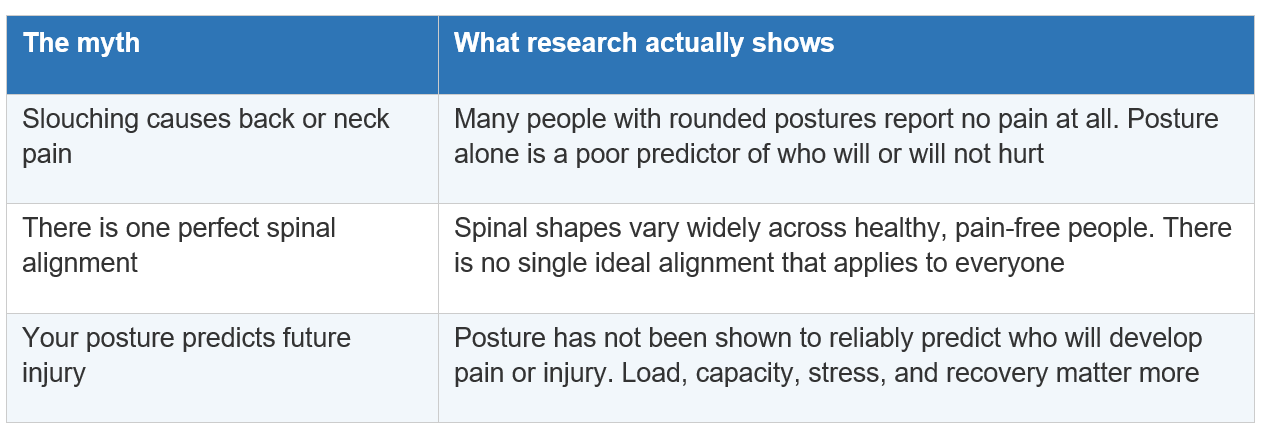
Infographic: Three posture myths vs. what the research actually shows
Pain is complex and personal. It often relates to a mix of things: how much load your body has taken over time, previous injuries or sensitive spots, stress, mood, and how safe your body feels, sleep quality and recovery, overall fitness and conditioning, and your beliefs and fears about posture and damage. When posture is treated as the only cause, we ignore this bigger picture. That can leave people feeling broken for no good reason, and sometimes more afraid to move than they need to be.
The belief that your spine is fragile can actually make pain worse, not because of any structural problem, but because your nervous system reads that fear as a reason to turn up protection. Hurt is not always harm. Sensitivity is not always severity. Pain relief is not always recovery.
Pain is a protective output of the brain, not a direct measure of tissue damage. What you believe about your posture and your body can shape how long pain lasts and how much it limits you. That is not a soft finding. It is neuroscience.
Why Capacity Matters More Than Keeping a “Straight Back”
Instead of chasing perfect posture, we find it more helpful to focus on capacity. Physical capacity is your ability to handle the demands of your life without feeling overloaded. It includes strength, mobility, balance, and cardiovascular fitness.
If your capacity is high, your body can handle more positions, more weight, and more activity with less trouble. You might lift a box with a rounded back, twist to grab a bag, or sit slouched on the couch for a while and feel fine, because your tissues and nervous system are used to handling different loads.
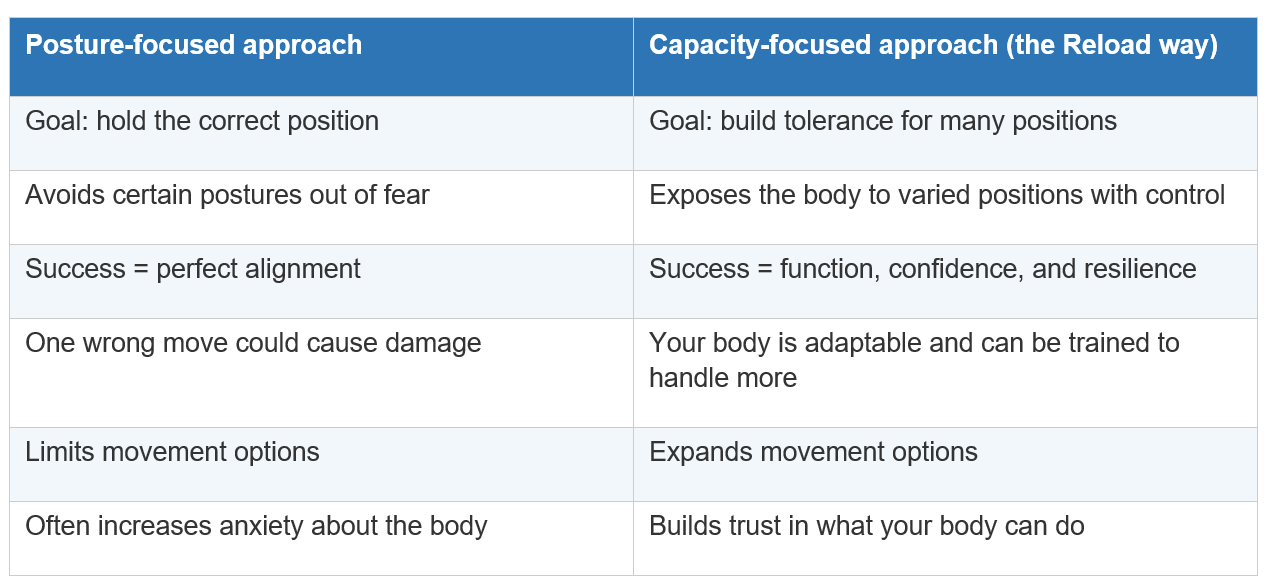
Posture-focused approach vs. capacity-focused approach
Your body likes change. Staying in a single ideal posture for hours, even if it looks great on a poster, can feel just as uncomfortable as slouching all day. Joints, muscles, and your nervous system respond well to regular shifts. Your best posture is your next posture.
Regular movement and activity support markers linked with health and longevity, like better heart health, stronger muscles, and healthier metabolism. That matters even more as we move through midlife and beyond.
Winter can make movement harder, especially in a city like New York where it is tempting to stay on the couch. Simple indoor options still count. Short strength sessions at home, a few sets of bodyweight squats between meetings, or walking laps in a hallway break up long sitting without obsessing over one perfect winter desk posture.
The point is not to follow a rigid schedule of movement breaks. The point is to give your body variety. When physical and non-physical stress add up in the same bucket, even small doses of movement throughout the day can change how your body feels by the evening.
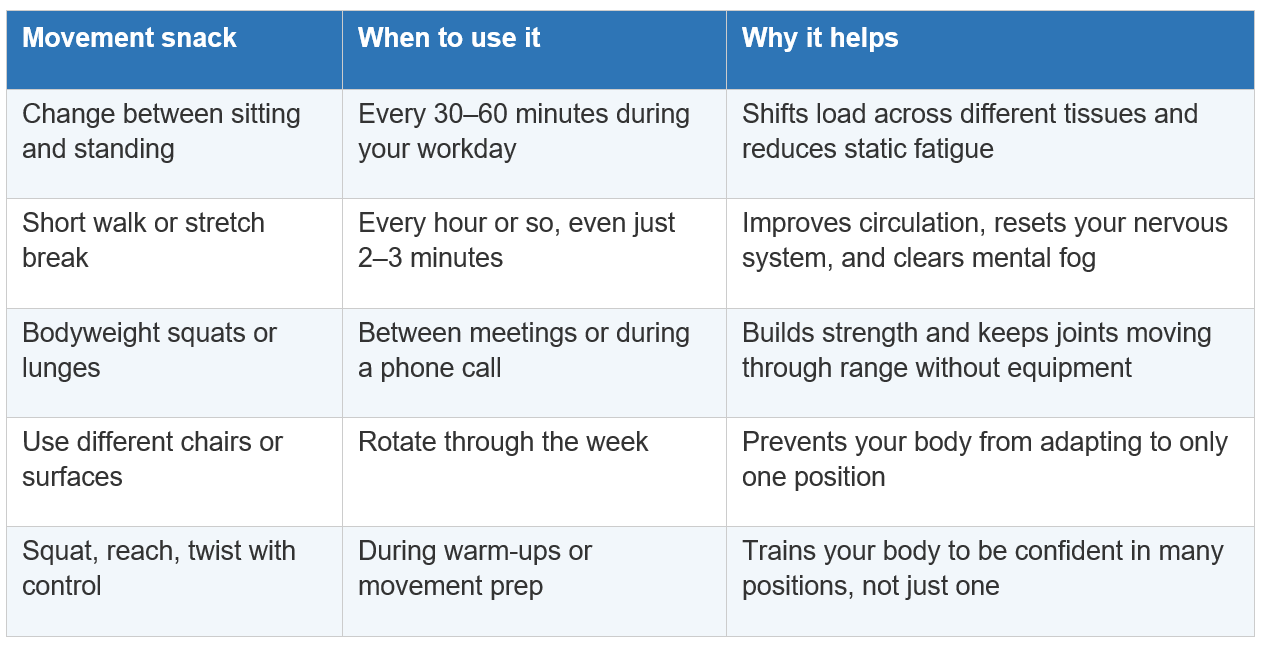
Movement variety ideas that actually fit real life
How Pain Really Works: Beyond One Bad Position
It is easy to think pain means “something is out of place” or “this posture is bad.” Pain does not work that simply. Pain is produced by your nervous system. It is a protective response that pulls together many signals at once.
Inputs that can influence pain include:
Current tissue load, like lifting more than usual
Old injuries or sensitive areas
Poor sleep or fatigue
High stress or low mood
Worry that a certain posture is harmful
This is why the same sitting position can feel fine one day and awful the next. The angle of your spine did not suddenly become dangerous. What changed was your overall load, sleep, stress, or recent activity. When we only blame posture, we miss these other drivers.
Instead, we like to frame pain as feedback about the match between demand and capacity. If your back flares up after a long day at the computer, it may be less about one “bad” curve and more about long static time, low movement variety, and not enough conditioning for that task. That view opens doors for more helpful solutions.
Personalizing Your Plan for Long-Term Health and Longevity
There is no one-size-fits-all posture program that works for everyone. Your history, sports, daily tasks, and long-term goals all matter. Someone who powerlifts needs a different plan than someone who wants to hike on weekends, even if both have the same slouch. Even when diagnoses sound similar, effective solutions are almost always individualized.
At Reload Physical Therapy and Fitness, an individualized approach often includes a detailed movement and strength assessment, a review of health history and previous injuries, a clear look at your goals for health and longevity, a progressive strength and conditioning plan that fits your life, and coaching on how to add movement variety into your day.
We are careful with generic internet advice. A fix your posture in 10 days routine might ignore what your body has been through, what calms your nervous system, and what you actually want to be able to do for the long term. Plans work best when they are built around you, not around a stock picture of a perfectly straight spine. We do not just treat a body part. We listen to the whole story, then design a plan that meets the full person.
At Reload, physical therapy, strength training, and health coaching work together under one roof. We re-test, ask questions, and look at how your body responds, then adjust. The plan is meant to change as you do, because your pain, capacity, and life demands will shift over time. Not in sessions. Over years.
If we could leave you with one idea, it would be this: chasing flawless posture is less helpful than building a body that can do what you care about, in many different positions, for many years. Strength, movement options, and a calm, informed view of pain do more for health and longevity than never letting your back round.
A useful way to start is by asking yourself a few questions: Which activities do you want to keep doing in your 60s and 70s? Where do you feel your current capacity holds you back? Which positions or movements are you avoiding because of fear, and how might you safely rebuild tolerance to them?
At Reload Physical Therapy and Fitness in New York City, we focus on these kinds of questions every day. Our goal is to help you move away from strict posture rules and toward a more flexible, confident, and strong version of yourself, so you can keep doing what you love for as long as possible.
Start Building Your Foundation for Lifelong Health
If you are ready to move better, feel stronger, and stay active as you age, we are here to help you take the next step. At Reload Physical Therapy and Fitness, our approach is designed around your long-term goals for health and longevity.
Reach out so we can learn about your history, your current challenges, and what you want your future to look like. Schedule a time to talk with our team through contact us and start a plan that supports you for years to come.
Book your first session at reloadpt.com or follow us at @reload.pt for more on pain science, movement, and healthy longevity.